
Weber LA 4050 P
Two-sided labeling LEGI-AIR 4050 P allows the labeling of two adjacent sides of a pallet. Up to 7 pallets can be processed per minute, depending on the application. Variable data (e.g. text, barcode or logo) are printed precisely and legibly on the labels immediately before the application procedure. The labels are subsequently applied using swing-arm […]
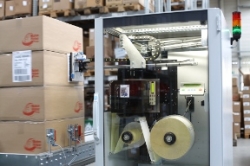
Two-sided labeling
LEGI-AIR 4050 P allows the labeling of two adjacent sides of a pallet. Up to 7 pallets can be processed per minute, depending on the application. Variable data (e.g. text, barcode or logo) are printed precisely and legibly on the labels immediately before the application procedure. The labels are subsequently applied using swing-arm technology with diagonal bar. This patented process is very safe: the pallet rolls back out in the event of a power failure, for example. If, in doing so, it should come into contact with the extended applicator arm, the bar automatically pushes the arm out of the way.
Flexible
Products of varying dimensions can be labelled due to the large swing-arm radius of 400 mm. Thanks to the Tamp-Blow, LEGI-AIR 4050 P can also flexibly label boxes, crates and other types of packaging, including convex or concave-shaped product surfaces. Labeling is possible in any conceivable installation position due to the symmetrical design. The compact dimensions of 1000 x 800 x 1200 mm (L x W x H) allow easy integration into existing production environments.
Ease of servicing
LEGI-AIR 4050 P has a built-in service interval counter which informs the user in good time of the next service date. Easy, fast replacement of individual components, due to wear for example, is also a practical feature due to the modular construction. The print module, for example, can be replaced with only 5 screws and 2 cables.
Technical specifications:
Printing technology
Thermal transfer or direct thermal
Print resolution
8 dots/mm (203 dpi)
12 dots/mm (300 dpi)
24 dots/mm (600 dpi)
Print speed
Up to 400 mm per second
Tamp sizes (mm)
Tamp-Blow standard of 150 x 210 to 160 x 250 mm, label lengths must be limited in accordance
with label quality, longer or smaller labels are possible using special tamps
Label gap
Minimum 3 mm
Label roll
300 mm diameter, up to 450 running meters, core 76 mm (3″), outside winding (optional inside winding)
Data interfaces
All common interfaces (see print modules leaflet for details)
Service interval
According to interval display
Positional accuracy of applied labels
Up to ± 2 mm on stopped product
Labeling security
2 product sensors for monitoring labeling area
2 optical sensors and 1 inductive sensor for monitoring product surface
Analogue pressure monitoring sensors
Label presence check on tamp
Patented labeling process
Patented diagonal bar as passive protection for tamp
Steel plate housing for protection from ambient effects
Print applicator activation
Light barrier, PLC output
Alarm equipment
Standard: error reporting display controller, digital I/O and 3-colour alarm lamp
Application capacity
Up to 7 pallets per minute without stopping product, the application capacity is dependent
on conveying speed, text change and stroke
Max. conveying speed on front labeling
18 m/min
Max. conveying speed on rear labeling
15 m/min
Compressed air consumption
2.1 l per application cycle, dependent on label size and setting
Compressed air connection
6 bar, the compressed air must be clean, dry and oil-free
Dimensions (L x H x W)
1000 x 1200 x 800 mm
Weight
From 300 kg (depending on model)
Electrical connection
90 to 263V AC, 50/60 Hz, 5 amps
Ambient conditions
Temperature: 10°C to 35°C, 15 to 85% relative humidity, non-condensing
(see separate leaflet on print modules).
Accreditation
CE-mark
All technical specifications are dependent on the print modules used (see separate leaflet
on print modules).
Choice of options:
RFID labeling
Test scanner
System base
IPC in protective housing
Legitronic® label printing and design software
Adobe Reader is required to open and view PDF files. This can be downloaded free from adobe.com.
Available Documents
Legi-Air 4050P leaflet printer- Choose from a wide range of 203, 300 and 600 dpi print engines
- Capable of handling print speeds up to 16 ips
- Numerous I/O’s ease interfacing with external devices
- Monitor operation via a web browser
Zebra ZT510 Industrial Printer
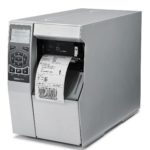
ZEBRA ZT510 – NEXT-GENERATION PRINTING THAT IS BUDGET-FRIENDLY
Designed to strike the ideal balance between performance and value, the Zebra ZT510 includes the core features you need in an industrial printer at a cost-effective price point.
View Product
Model 5300 Series Twin-Tamp Label Printer-Applicator
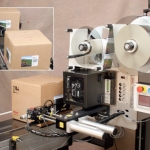
Weber’s Model 5300 Twin-Tamp label printer applicator combines a high-performance thermal/thermal-transfer label printer with a specially configured applicator to satisfy the printing and two-label, adjacent-panel application of carton labels in line.
Zebra LS1203 Barcode Scanner
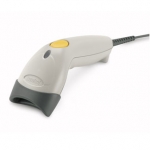
The Symbol LS1203 handheld scanner from Zebra delivers high quality laser scanning, user-friendly ergonomics and durability at an affordable price. Designed to meet the needs of small businesses, the Symbol LS1203 provides the performance and features needed to significantly reduce data entry errors and boost productivity day in and day out in gift shops, boutiques, sporting goods, jewelers, video stores, florists and other small local retailers. Easy and comfortable to use, this high-value cost-effective scanner offers the reliability and investment protection that have made Zebra the global leader in handheld bar code scanning.
View ProductPrimary labels / pre-printed labels
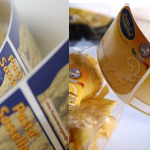
Brands and high-quality products need suitable labels to represent the image and reflect the branding. Weber Marking Systems is geared for the production of high-quality primary and pre-printed labels for any application.
View Product