
Model 5300 Series Swing-Tamp Pallet Label Printer-Applicator
This Weber exclusive provides high-resolution printing and high-speed operation combined with the swing-tamp method of label application that affixes a label to the leading or trailing side of a pallet load.
- Choose from a wide range of 203, 300 and 600 dpi print engines
- Capable of handling print speeds up to 16 ips
- Numerous I/O’s ease interfacing with external devices
- Monitor operation via a web browser
- Available with RFID capability
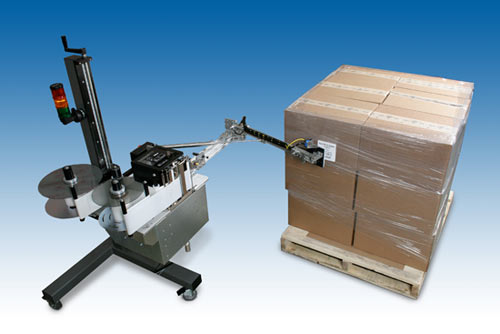
Model 5300 Series Swing-Tamp Pallet Label Printer-Applicator
Weber’s Model 5300 swing-tamp pallet system is redefining the meaning of versatility in the printing and application of pressure-sensitive labels to the leading or trailing side of a pallet load.
In addition to offering a broad selection of high-quality print engines that feature various print resolutions and label dispensing rates, the Model 5300 system is available with optional RFID print-encode engines.
Standard direct and thermal-transfer print engines from manufacturers Zebra, SATO and Datamax produce text, bar codes and graphic images at 203, 300 or 600 dpi. The Zebra-based RFID models combine these printing capabilities with the encoding and verification of RFID inlays to meet EPC Gen 2 protocols.
Special Features & Options
The Model 5300 swing-tamp pallet labelling system includes a number of noteworthy features that add to the operational versatility of this printer-applicator:
• Swing-tamp application: This method of label placement is used to apply a label to the front or back of a pallet. A printed label is fed onto a pad and held by vacuum, the unit’s 90-degree swing arm then extends to apply the label.
• Browser-based monitoring: The status of all operational functions and configurations can be monitored by logging on to a web page that is unique to each Model 5300 unit.
• Numerous I/O’s: The system can be interfaced with many types of external devices.
• One-to-one media consumption: Special label unwind and rewind dimensions are matched to the system’s ribbon supply to ensure they are consumed at the same rate, reducing downtime and eliminating partial changeovers.
• Print job storage: Multiple label printing formats can be stored in the system’s memory, making it easier for an operator to select a job directly from the applicator instead of downloading a computer file.
The Model 5300 swing-tamp pallet system boasts numerous additional features including an upgradeable microprocessor controller, various inputs/outputs, plus durable construction that will withstand harsh industrial environments.
There also are several optional enhancements that can increase the system’s functionality. A product height sensor, for example, enables the printer-applicator to label pallets of varying heights.
Other options include a 15-foot umbilical connection that enables the remote location of the unit’s controller, an adjustable stand for optimum system orientation, label-on-pad and product-presence sensors plus beacon light alerts to signal the status of label and ribbon supply.
Adobe Reader is required to open and view PDF files. This can be downloaded free from adobe.com.
Available Documents
5300Markoprint NonStop Printing
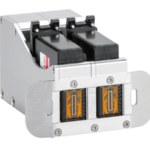
To enable continuous marking in ongoing production, our Markoprint NonStopPrinting printhead holds two alternately printing cartridges. Because the other ink cartridge is printing on the same position, each ink cartridge can be changed, cleaned, or serviced without pausing the machine.
An intelligent automatism prevents both cartridges from going empty at the same time. The first cartridge will always print two consecutive print jobs, taking turns with the second cartridge, which will only print one. This sophisticated automatism avoids both cartridges from running out at the same time. This will keep the ink from drying out in both cartridges. When the cartridge with the larger print volumes is empty, a warning will show, and the other cartridge will continue printing until it is replaced. The new cartridge will print the lower quantities to allow for you to replace the “older” cartridge. A sophisticated workflow that will boost your efficiency and productivity.
View ProductWeber Label Printers and Dispensers
For manufacturers, wholesalers, retailers and offices, investing in high-quality and efficient label printers to have on the premises can bring significant long-term cost and time savings for your business. Up-to-date, accurate and fast labelling of products is essential in today’s production and business world. With such a depth of experience and broad expertise, Weber Packaging Solutions is your best choice for label printers and label applicators in the UK & Ireland.
View ProductWeber LA2050 – Compact Entry Level Print & Apply
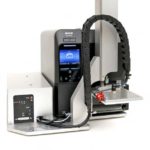
The compact and low-cost LA2050 label print and apply system is designed for automated print and apply processes on a production line. It can also be used in semi-automatic mode where automatic label application is not required with the system being used as a label print and dispense system, with the label applicator system being initiated manually by the operator.
View ProductSATO DS Keyboard
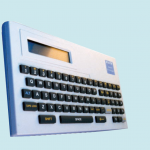
The clever and compact SATO Smart Keyboard enables you to use your label printer independent from computers or networks.
View Product