
Mobile Print & Ship and Online Print & Ship
“Mobile Print & Ship” uses an RFID desktop printer placed on a mobile trolley which can be used for a variety of production and logistics scenarios. Using this system, tags can be defined and printed locally at the product itself. The operator first scans the pallet barcode, which is then transmitted to the printing unit. […]
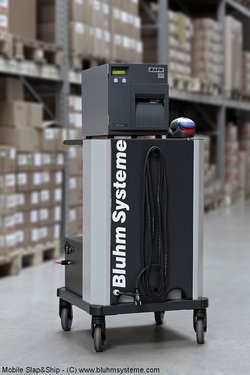
“Mobile Print & Ship” uses an RFID desktop printer placed on a mobile trolley which can be used for a variety of production and logistics scenarios. Using this system, tags can be defined and printed locally at the product itself.
The operator first scans the pallet barcode, which is then transmitted to the printing unit. The printer then uses this barcode data as input for the creation of an EPC (Electronic Product Code). Finally, the labels are applied by hand to the items.

The “Online Print & Ship” solution also involves the use of an RFID desktop printer. However, in contrast to the “Mobile Print & Ship” variant, the “Online Print & Ship” solution is a fixed installation, equipped with an online connection. The solution is necessary in situations where the packaging does not contain all of the information required for the automatic generation of an EPC – such as the EAN-18 number, for example. In such cases, the package or order number must be checked against a database (for example) in order to determine the EPC that should be generated.
Another scenario in which an online connection is advisable is when the ordinary EPC generation and labelling process needs to be documented in the company’s own database.
Both the “Mobile Print & Ship” and “Online Print & Ship” systems can process label formats from 19 x 6 mm to 228 x 2,540 mm and come with a “Flag Tag” option, which increases the read performance of RFID tags on metal surfaces or with liquids.
RFID desktop printer Zebra R110Xi4
This high-performance industrial printer enables by combination with the innovative adaptive RFID-Coding Technology a maximum flexibility with printing, respective coding of RFID SmartLabels and up to all „Inlays“. Hereby the Zebra R110Xi4 is particularly suitable for customers that have to process a high number of different SmartLabel- or even Inlay-variants with a high output.
Benefits from the Zebra R110Xi4:
- RFID-Desktop Printer optimized for high quantities of labels to be printed
- flexible by adaptive RFID-coding technology (a combination of several reader-elements), enables to write on different types of transponder, if necessary also in various positions
- cost-efficient for consumables as RFIDTransponder (so-called „Inlays“) can be coded also, thus SmartLabels are not required
Adobe Reader is required to open and view PDF files. This can be downloaded free from adobe.com.
Available Documents
Tamper Evident Label Applicator
A core requirement of the European Directive 2011/62/EU that will come into force by 2016 is to equip the outer packaging of medicals with a tamper evident feature. Which should ensure the customer that he is the first opening the package.
View ProductEasyGo! ProductCheckPro
Summary
Manage your stock by checking the properties of your products and verifying they are correct. Alert, by incidents, the failures of the products checked. Send the incident report to the server to solve it or to have a movement report. Finally, print product related labels from your handheld device via cable, WiFi or Bluetooth.
View ProductSATO TH2 | 2″ Mobile Thermal Printer
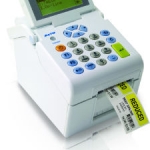
Portable, Handy, Smart. The TH2 direct thermal 2″ standalone printer is truly revolutionary.
View ProductBottle-Matic Label Applicator
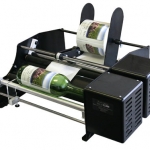
This table top labelling system is deal for applying single pressure-sensitive labels to cylindrical objects like bottles and cans. These are perfect for small craft brewery or vineyard labelling applications.
The Bottle-Matic label applicators are available in 10″-wide and 16″-wide models that fit most products. The unit is fully adjustable so you can label objects from 0.5″ to 10″ diameter; ideal for everything from test tubes to 1.5-gallon bottles.
View Product